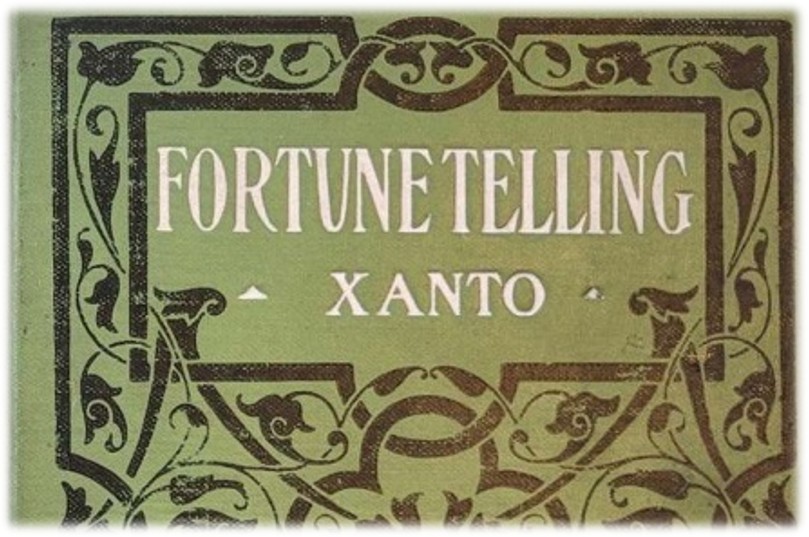
Our recent ice storm had me rooting around my library in search of something strange and spooky. My hunt produced an odd little treasure, Fortune Telling by Xanto. It is the 1911 edition published by The Penn Publishing Company of Philadelphia.
The book is an early‑20th‑century occult and divination handbook published by The Penn Publishing Company of Philadelphia. The 1911 edition is considered a rare antique, often collected for its Art Nouveau‑style binding and its place in the era’s fascination with mysticism and pseudoscience. This book was part of a turn‑of‑the‑century occult revival, when Americans were fascinated by spiritualism, divination, phrenology, and esoteric European traditions. This book mixes practical instructions with pseudoscientific beliefs that were popular at the time.
The book is a small green hardcover of compact size (6” in length, 4.5 inches in width, and .5 inches in depth) . The 1911 edition is part of a series of reprints from the same publisher. The 1901 and 1910 editions share similar content and design.
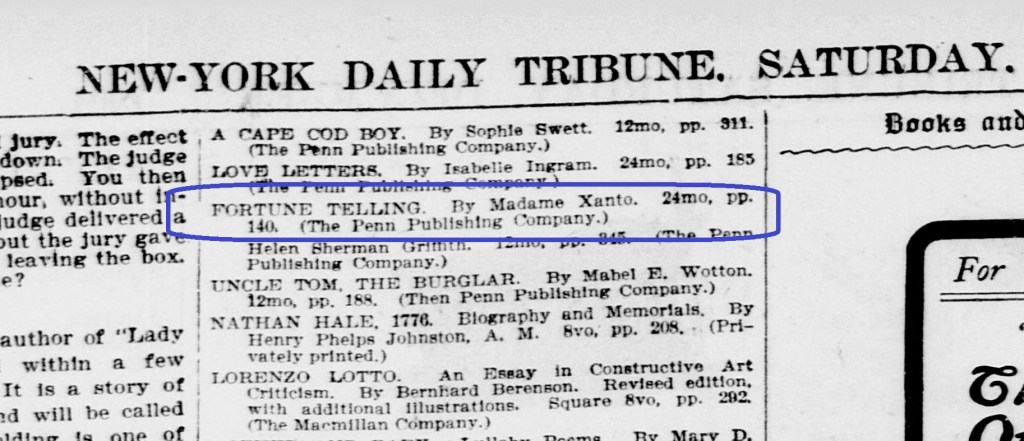
The book is a comprehensive guide to early‑1900s fortune‑telling practices, including card reading, palmistry (palm reading), tea‑leaf reading, Napoleon’s Oraculum — a popular 19th‑century fortune‑telling system, instructions for creating and using love charms, and Phrenology — the now‑discredited practice of reading skull bumps to determine personality. Who is Madame Xanto? Her identity is unknown based on my research. I have found no biographical information, dates, or personal history documented in any authoritative source. Even the historical newspapers at loc.gov produced little more than advertisements like the image noted below from the New-York Daily Tribune, December 7, 1901. This is typical of early‑20th‑century occult authors, many of whom used pseudonyms to give their work a mystical aura.
I have digitized this book for your entertainment; it is available here in my Etsy shop. Be aware, many vintage books reflect the cultural norms and language of the era in which they were created. This book is no exception. Readers should be aware that it may contain terminology, descriptions, or viewpoints that are considered inappropriate or offensive by today’s standards. These elements are preserved here as part of the historical record, not as an endorsement of the ideas expressed. Approaching the text with this context in mind can help readers better understand the period in which it was written and the ways societal attitudes have evolved over time.
 mummey.com
Leave a comment